A Few Facts
Timber Treatments
What You Need to Know
Why Do We Treat Timber?
Think of timber treatment as a protective shield. It helps your frames and trusses stand up against termites, borers and fungi that can weaken timber over time. In short — treatment boosts durability so your timber lasts longer where it matters most.
But here’s the catch: treatment doesn’t protect against weathering. Sun, rain and UV will still take their toll, so any exposed timber should always be coated or oiled for extra protection.
Types of Preservatives
Water-borne Preservatives
(e.g. CCA, ACQ, Copper Azole)
Light Organic Solvent Preservatives (LOSPs)
(e.g. TBTN, azoles, permethrin)
Envelope Treatments
(e.g. Blue Pine treated with permethrin or bifenthrin)
Oil-borne Preservatives
(e.g. PEC – pigment emulsified creosote)
Together, these details mean your frames arrive ready to install, accurate, well-organised, & built to last.
No wasted time, no confusion on site, and no unexpected delay. Just straightforward framing solutions that keep your build moving.
Are All Treatments the Same?
There is a variety of treatments available.
Some treatments protect the timber against borers and/or termites; others protect the timber against insects, borers and decay.
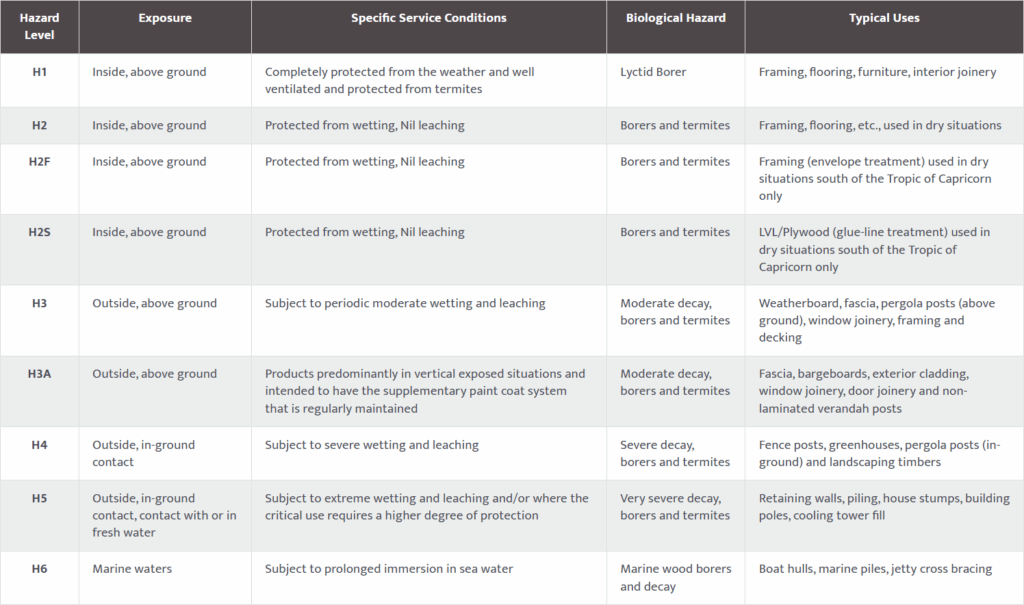
Different preservatives are used for different protection requirements or Hazard Levels. There are 6 Hazard Levels (see table below) which are based on the hazardousness of the exposure.
Different Hazard Levels have different preservatives, different preservative penetration patterns and different preservative retention requirements.
Hardwoods treated to H1 level will have all the sapwood penetrated. There is no need to penetrate the heartwood because lyctids do not attack the heartwood. For the rest of the levels, H2 to H6 inclusive, the penetration from the surface by the preservative increases and the amount of preservative in the treated envelope increases as the hazardousness of the exposure level increases.
Levels of Treatment - Hazard Levels
There are six main levels of treatment and a number of sub-levels.